How does AI sales compare to manual outreach?
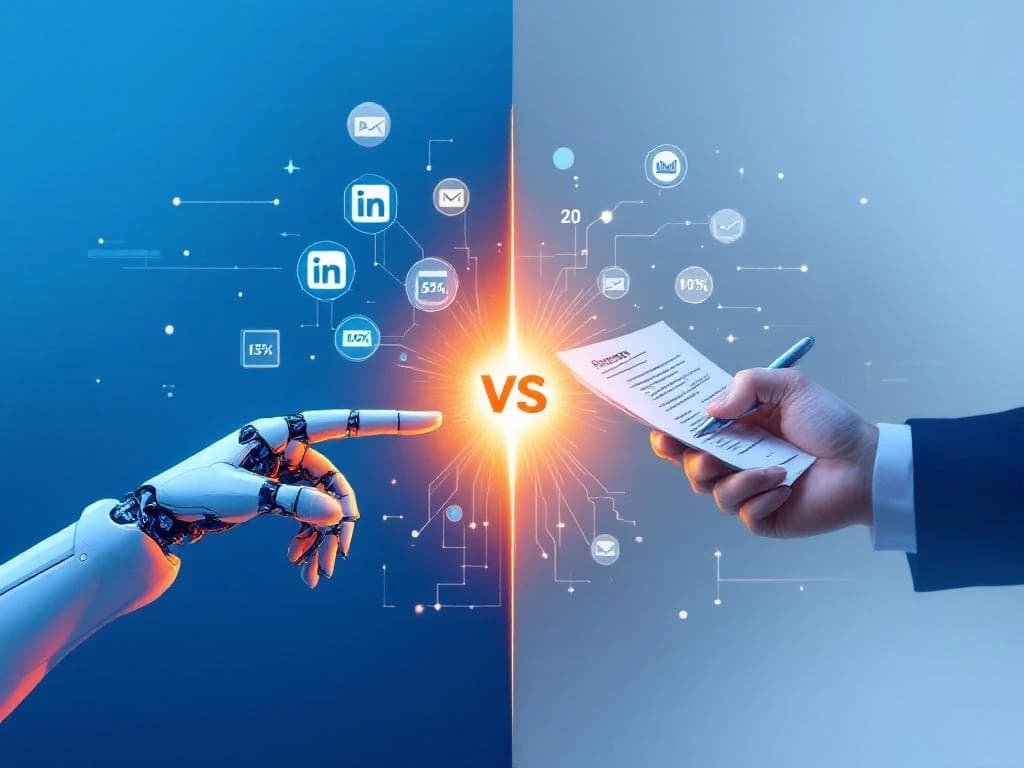
AI sales automation uses artificial intelligence to handle lead identification, message personalisation, and follow-up sequences automatically, while manual outreach requires sales teams to research prospects and craft individual messages by hand. AI sales can process thousands of prospects simultaneously with consistent messaging, whereas manual outreach is limited by human capacity but offers complete control over personalisation. The best approach often combines both methods, using AI for scale and human oversight for relationship building.
What exactly is AI sales automation and how does it work?
AI sales automation is technology that uses artificial intelligence to handle repetitive sales tasks like finding prospects, personalising messages, and managing follow-up sequences without constant human intervention. The system analyses prospect data from platforms like LinkedIn to create targeted outreach campaigns that run automatically.
The technology works through several core functions. First, it identifies potential customers by scanning professional profiles and company information to match your ideal customer criteria. Then it crafts personalised messages by analysing each prospect's background, recent activity, and professional interests to create relevant conversation starters.
AI sales systems also handle response classification, automatically categorising incoming messages into types like meeting requests, information requests, or follow-up scheduling needs. This allows the system to provide appropriate responses or flag conversations that need human attention.
The automation extends to relationship nurturing as well. These systems can engage with prospects' content, send connection requests at optimal times, and maintain visibility across large networks through strategic interactions. All of this happens while you focus on closing deals and building relationships with qualified prospects.
How much time does AI sales automation actually save compared to manual outreach?
AI sales automation can handle the workload equivalent of entire sales departments, allowing small teams to manage thousands of prospects simultaneously. While a salesperson might manually reach out to 20–50 prospects per day, AI systems can engage hundreds daily while maintaining personalisation and consistent follow-up.
Manual outreach typically requires 15–30 minutes per prospect when you factor in research, message crafting, and follow-up tracking. This means reaching 30 prospects manually takes roughly 7–15 hours of dedicated work. AI automation reduces this to minutes of setup time for campaigns that run continuously.
The time savings become more significant with follow-up sequences. Manual sales processes often lose prospects because team members forget to follow up or delay responses. AI systems send follow-ups at optimal intervals and respond to inquiries within minutes, maintaining engagement momentum that manual processes struggle to match.
However, you'll still need time for strategy development, campaign optimisation, and handling qualified conversations that require human insight. The automation handles the repetitive prospecting work, freeing up your time for relationship building and closing deals with interested prospects.
What's the difference in personalisation between AI and manual sales approaches?
Modern AI personalisation analyses prospect profiles, recent posts, and professional background to create contextually relevant messages that reference specific details about each person's work and interests. Manual personalisation offers complete creative control but is limited by the time available to research each individual prospect.
AI systems can identify personalisation opportunities that humans might miss, such as recent job changes, shared connections, or industry-specific challenges mentioned in posts. They process this information instantly across hundreds of prospects, creating messages that feel individually crafted while maintaining consistency in your brand voice.
The key difference lies in scale versus nuance. Manual personalisation allows for complex emotional intelligence and cultural context that AI currently cannot match. You can pick up on subtle cues, industry insider knowledge, and relationship dynamics that require human understanding.
However, AI personalisation has become sophisticated enough that recipients often cannot distinguish between AI-generated and human-written messages when the system is properly configured. The technology references specific timeframes, mentions relevant experience, and creates authentic conversational flow rather than robotic responses.
The most effective approach combines both: AI handles the initial personalisation at scale, while humans take over for high-value prospects or complex conversations that require emotional intelligence and strategic thinking.
Which approach delivers better response rates for B2B sales teams?
AI-driven outreach often achieves higher response rates than manual efforts because it ensures consistent follow-up, optimal timing, and maintains engagement across large prospect pools without human limitations like fatigue or forgetfulness. Manual outreach can achieve excellent results with individual prospects but struggles to maintain quality across hundreds of conversations.
The response quality differs between approaches. AI systems excel at generating initial interest and moving prospects through early qualification stages. They respond immediately to inquiries, never miss follow-up opportunities, and maintain consistent messaging that builds familiarity over time.
Manual outreach typically performs better in complex sales situations requiring nuanced communication, handling objections, or building relationships with high-value prospects who expect personalised attention. Human salespeople can adapt their approach mid-conversation and respond to emotional cues that AI cannot detect.
Success rates depend heavily on implementation quality. Well-configured AI systems with proper personalisation and human oversight often outperform manual outreach teams because they eliminate common human errors like inconsistent follow-up or delayed responses. Poorly implemented automation produces generic messages that damage response rates.
The timing factor significantly impacts results. AI systems can engage prospects when they're most active on platforms like LinkedIn, respond to inquiries within minutes, and maintain conversation momentum that manual processes often lose during busy periods or outside working hours.
How do you choose between AI sales tools and manual outreach for your team?
Choose AI sales automation when you need to scale outreach beyond your team's manual capacity, have clearly defined ideal customer profiles, and want consistent follow-up processes. Manual outreach works better for complex sales cycles, high-value prospects requiring personalised attention, or when your team has sufficient capacity for thorough individual research.
Consider your current sales volume and targets. If you need to reach hundreds or thousands of prospects monthly, manual processes become unsustainable. AI automation makes sense when you're looking to build substantial prospect databases and nurture relationships at scale while maintaining quality interactions.
Evaluate your team's expertise and available time. Manual outreach requires skilled salespeople who can research prospects effectively and craft compelling messages consistently. AI systems need initial setup and strategy development but then operate with minimal daily intervention.
The hybrid approach often delivers the best results. Use AI automation for initial prospecting, lead qualification, and relationship nurturing, then transition qualified prospects to human salespeople for complex discussions and closing. This combines the scale benefits of automation with the relationship-building strengths of human interaction.
For LinkedIn specifically, our AI-driven campaign automation system handles the prospecting and initial engagement phases, allowing your team to focus on qualified conversations. The system builds familiarity with prospects through strategic interactions before human salespeople engage, creating warmer conversations and higher conversion rates.
Consider starting with automation for routine prospecting tasks while maintaining manual control over high-value opportunities. You can gradually expand AI involvement as you see results and become comfortable with the technology. This approach lets you test effectiveness while minimising risk to important relationships. For more information about implementing this balanced approach, you can contact us to discuss your specific requirements.
Frequently asked questions
How do I get started with AI sales automation if my team has never used it before?
Start with a pilot campaign targeting a small segment of your prospects (50-100) to test messaging and response rates. Choose one specific use case like LinkedIn outreach or email follow-ups, set up basic personalisation rules, and run the campaign for 2-3 weeks while monitoring results closely. This allows you to learn the system and refine your approach before scaling up to larger prospect volumes.
What are the most common mistakes teams make when implementing AI sales automation?
The biggest mistakes include using generic messaging without proper personalisation, setting up overly aggressive follow-up sequences that annoy prospects, and failing to monitor campaign performance regularly. Many teams also make the error of completely removing human oversight, which leads to missed opportunities and poor relationship management with qualified leads.
How do I maintain authenticity in my outreach when using AI automation?
Focus on creating detailed prospect personas and personalisation rules that reference specific professional details, recent achievements, or industry challenges. Use your actual voice and writing style when setting up message templates, and ensure the AI references genuine commonalities like shared connections, similar experiences, or relevant content the prospect has shared.
When should I transition a prospect from AI automation to manual handling?
Move prospects to manual handling when they show genuine interest (asking specific questions, requesting meetings, or engaging in detailed conversations), when they're high-value targets worth significant investment, or when the conversation requires complex problem-solving that goes beyond standard qualification questions. Set up clear triggers in your system to flag these transitions automatically.
How do I measure the ROI of AI sales automation compared to manual outreach?
Track metrics like cost per qualified lead, time spent per conversion, total prospect volume handled, and response-to-meeting conversion rates for both approaches. Calculate the hourly cost of manual outreach (salary + time) versus automation costs, then compare the number of qualified opportunities generated. Most teams see 3-5x improvement in prospect volume with similar or better qualification rates.
Can AI sales automation work for complex B2B sales with long sales cycles?
Yes, but it's most effective in the early stages of long sales cycles for initial prospecting, lead qualification, and relationship nurturing. Use AI to identify and warm up prospects over several months through valuable content sharing and strategic engagement, then transition qualified leads to human salespeople for complex discussions, demos, and relationship building that longer sales cycles require.